Do 14x28x4 Air Filters Reduce Cooking Odors?
In our years serving South Florida homes, we have answered this question more than almost any other one: " My house still smells like dinner three hours later, can a better air filter actually fix that? The honest answer is yes, but only if you pick the right kind. A standard pleated 14x28x4 will catch the dust, lint, pollen, and grease aerosols that come off the stovetop, although it will not touch the gas-phase molecules that make smells linger. For that, you need a carbon-activated 14x28x4 filter, used together with a working range hood and a replacement schedule that fits how you actually cook.
TL;DR Quick Answers
14x28x4 Air Filters
A 14x28x4 air filter is a 4-inch deep pleated HVAC filter sized 13.5 by 27.5 inches actual. It works on particles like dust, pollen, smoke, and grease aerosols when paired with the right MERV rating. For cooking odors specifically, you want a carbon-activated 14x28x4, because activated carbon traps the gas-phase molecules that pleated media on its own cannot reach.
Top 5 Takeaways
Standard pleated 14x28x4 air filters trap particles like dust and grease aerosols, but they do not pull gas-phase cooking odors out of your indoor air.
Carbon-activated 14x28x4 air filters are what you want when kitchen smells are part of daily life, and they help with pet odors and lingering smoke for the same reason.
The actual size of a "14x28x4" is 13.5 by 27.5 by 4 inches. Always measure your slot before ordering.
MERV 13 is the practical ceiling for most South Florida residential systems. Have someone check your airflow capacity before going higher.
Carbon saturates faster than pleated media. Plan to replace carbon-activated 14x28x4 filters every 3 to 6 months in cooking-heavy households.
Why Cooking Smells Hang Around Longer Than They Should
Your 14x28x4 air filter is doing real work. It sits in your return cabinet and cycles indoor air through a pleated mat of fibers many times an hour. The part it cannot do is grab the gas-phase molecules that cooking releases. That is why the smell from last night's dinner is still around at breakfast, even though your filter has been running the whole time.
When you cook anything with strong aromatics, two different things hit your indoor air. The first is particulate matter, which covers smoke, grease aerosols, and fine droplets you can sometimes see. The second is volatile organic compounds, which are gases. Your pleated filter handles the particle side cleanly, but VOCs slip right through the fibers because pleated media was not built to catch gas molecules in the first place.
In Weston and the rest of South Florida, this gets worse before it gets better. Your home stays sealed up most of the year because the AC is running, and your return pulls the same indoor air across the filter again and again. Those gas molecules keep coming back through. Homes in cooler climates can open a window and clear the air. We do not get that option here for most months.
What A 14x28x4 Filter Does Well
Even though a regular pleated 14x28x4 air filter will not solve odors on its own, do not write it off. The 4-inch depth alone is a real upgrade over a 1-inch slot filter. More media surface area means it grabs more particles before pressure builds across the pleats, and it lasts longer between changes. For a Florida air handler running most of the year, that depth pays for itself.
Here is how the common ratings actually shake out for a 14x28x4 in a residential system:
14x28x4 air filter MERV 8: Catches dust, lint, pollen, dust mite debris, and pet hair. A solid baseline for a healthy home with no specific air quality concerns.
14x28x4 air filter MERV 11: Adds finer particles, including mold spores, smoke residue, smaller pet dander, and some bacteria fragments. A good middle ground for households with allergies or pets in the home.
14x28x4 air filter MERV 13: Captures bacteria-size particles and sub-micron smoke. The highest rating most residential systems can run without choking airflow.
One quick warning on MERV 13. Going straight from MERV 8 to MERV 13 sometimes causes static pressure problems on older systems. If your blower was sized for a low-restriction filter, the higher-MERV pleat can put extra strain on it. Not always, but often enough that we tell homeowners to ask their HVAC tech to check static pressure before leaping.
Why Carbon-Activated 14x28x4 Filters Are The Real Odor Answer
If cooking smells brought you here, this is the part that actually solves the problem. A carbon-activated 14x28x4 has a layer of activated carbon, sometimes called activated charcoal, bonded into or laid behind the pleated media. Activated carbon is microporous, meaning each granule has a massive amount of internal surface area. Gas molecules drift into those pores and get held there through adsorption. That is the part standard pleated media cannot do.
We see carbon-activated 14x28x4 filters earn their cost in homes where odors are part of everyday life: families that fry or sear several nights a week, households with multiple pets, anyone living with a smoker, or homes near busy streets where outdoor exhaust drifts inside through windows and doors. They also help with VOCs from cleaning products and off-gassing from new furniture, which is a side benefit most people do not shop for but appreciate once they notice it.
The trade-off is saturation. Activated carbon does not last forever. Once those pores fill up with adsorbed molecules, the filter stops pulling new gases out of the air, even if the pleats still look clean from the outside. In a heavy-cooking household running AC year-round in Florida, carbon-activated 14x28x4 filters typically run 3 to 6 months. Standard pleated 14x28x4 air filters can stretch to 6 to 12 months, although cooking and humidity shorten that window. If you want a longer breakdown of replacement timing across filter types, we walk through it in our piece on how often to replace HVAC air filters in your home.
Getting The Size Right: 14x28x4 Vs. 13.5x27.5x4
Here is a small detail that causes real headaches every week. A "14x28x4" filter is not 14 by 28 by 4 inches. The actual size is 13.5 by 27.5 by 4 inches, and some manufacturers cut at 13.5 by 27.5 by 3.75. The label lists the rounded nominal dimension, and the filter itself runs slightly smaller, so it slides into the cabinet without binding.
What that means for you in practical terms:
Measure your filter slot in the return, not the old filter.
Check the printed dimensions on the existing filter to confirm sizing.
If your slot measures roughly 14 by 28 by 4 inches, a 14x28x4 (actual 13.5x27.5x4) is your size.
Listings for "14 x 28 x 4 air filter" and "13.5x27.5x4 air filter" point to the same product.
The 14x28x4 size fits a range of 4-inch slot cabinets, including most Lennox, Trane, Bryant, and Carrier units, although exact OEM cabinet dimensions shift from one model year to the next. If you are replacing an existing 14x28x4 and the system was running fine, sticking with the same nominal size is the safe move.
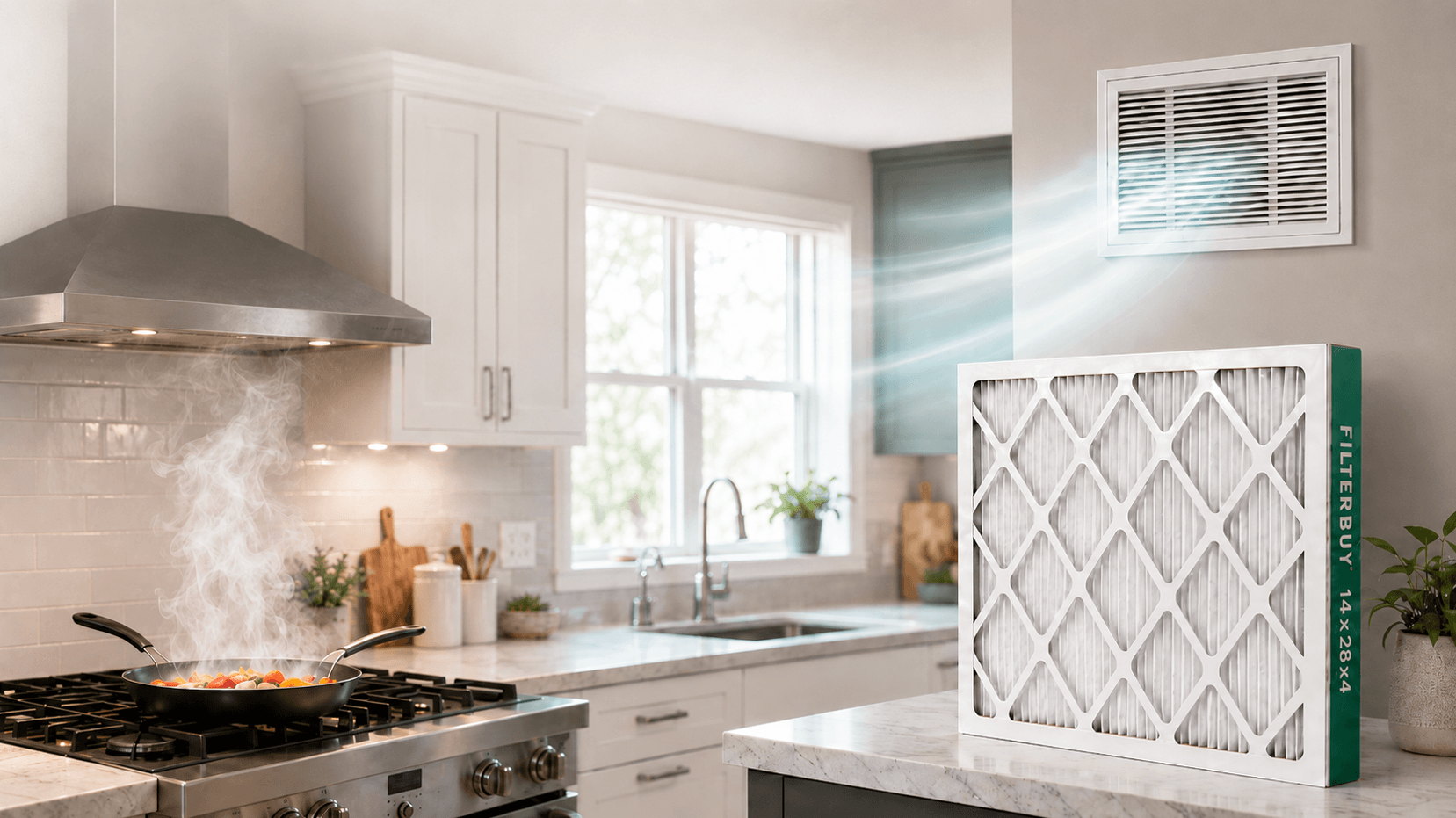
"Homeowners ask us all the time whether jumping to a higher MERV rating will fix kitchen smells, and the honest answer is no. MERV ratings sort particles by size, while activated carbon traps gas molecules through a different mechanism altogether. For cooking odors, the right move is a 14x28x4 carbon-activated filter that fits your actual cabinet, used together with a vented range hood, and changed on a schedule that matches how often you cook."
Essential Resources On 14x28x4 Air Filters
Before you settle on a filter, here are seven trustworthy reads from U.S. agencies and standards bodies. We picked each one because it covers a piece of the picture homeowners ask us about most often.
1. Where Indoor Particulate Matter Actually Comes From
The EPA breaks down the indoor sources that load up your filter, with cooking near the top of the list. Useful context for why a 14x28x4 in a kitchen-active home works harder than one in a quiet office.
Source: EPA — Sources of Indoor Particulate Matter (PM)
2. Practical Steps To Improve Indoor Air At Home
The American Lung Association's plain-language guide covers the small habits that make filtration more effective in real homes, including running your range hood every cook session and managing indoor humidity below 50 percent.
Source: American Lung Association — Low-Cost Ways to Improve Your Indoor Air Quality
3. CDC Guidance On Cleaner Indoor Air
The CDC walks through how filtration, ventilation, and air movement work together in a residential system. A useful read before you decide how aggressive to go on the MERV rating in your specific home.
Source: CDC — Taking Steps for Cleaner Air for Respiratory Virus Prevention
4. Debunking Myths About MERV And Air Filtration
ASHRAE wrote the standards that define MERV ratings. This article from their journal cuts through marketing claims and gets to what each rating actually delivers in a residential system.
Source: ASHRAE Journal — Debunking Myths About MERV and Air Filtration
5. How To Maintain An Efficient Air Conditioner
The U.S. Department of Energy's quick guide on filter changes and routine maintenance, with the energy-bill math behind each recommendation built right in.
Source: U.S. Department of Energy — Air Conditioner Maintenance
6. NIH MedlinePlus Overview Of Indoor Air Pollution
A neutral, plain-English health reference on what indoor air pollution does to the body and where it tends to come from. Helpful if anyone in your household has asthma or allergies you are trying to manage.
Source: MedlinePlus (NIH) — Indoor Air Pollution
7. The Inside Story: A Guide To Indoor Air Quality
The Consumer Product Safety Commission's full guide to indoor air, including a section on combustion appliances and back-drafting. Worth a read if you have a gas range, fireplace, or attached garage.
Source: CPSC — The Inside Story: A Guide to Indoor Air Quality
Supporting Statistics
Three numbers worth keeping in mind when you are picking a 14x28x4 air filter for a Florida home:
1. Heating and cooling make up nearly half of household energy use, and a clogged filter forces the system to work harder. Energy Star recommends inspecting, cleaning, or changing air filters once a month in your central air conditioner, furnace, or heat pump.
Source: Energy Star — HVAC Maintenance Checklist
2. Indoor air can be more polluted than outdoor air, according to the Asthma and Allergy Foundation of America, which also notes that people spend up to 90 percent of their time inside. A higher-MERV 14x28x4, paired with carbon if odors are part of the picture, directly reduces several common indoor triggers.
Source: Asthma and Allergy Foundation of America — Improving Indoor Air Quality
3. Indoor air pollutants can include particulate matter, allergens, oxides of nitrogen, endotoxin, and mold, according to the National Institute of Environmental Health Sciences, which links these exposures to impaired health and performance in children and adults. That mix is the reason a multi-stage carbon-activated 14x28x4 makes such a difference in lived-in homes.
Source: National Institute of Environmental Health Sciences — Indoor Air Quality
Final Thoughts And Opinion
A 14x28x4 air filter alone will not fix a kitchen-odor problem. That is the honest answer, and it is the one most ranking pages tiptoe around.
Here is how we would think it through for your home:
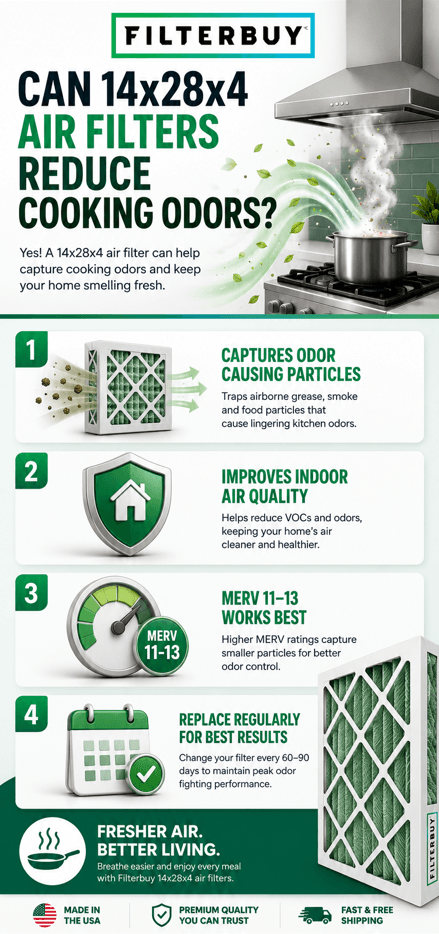
Choose your filter type based on the actual problem. If you are only worried about particles, a pleated 14x28x4 in MERV 11 or 13 will do the job. Once cooking odors enter the picture, carbon-activated is the right pick.
Match MERV to your system. If your air handler cannot push air through MERV 13 cleanly, drop to MERV 11. A struggling system is harder on your equipment than a slightly lower filter rating.
Replace on a schedule, not when you remember. Set a calendar reminder every 3 to 6 months for carbon, 6 to 12 months for standard pleated.
Run your range hood every cook session, even when there is no visible smoke. The hood pulls odors at the source, so your filter has less work to do afterward.
After manufacturing filters for over a decade and serving more than two million households, we have found that the homeowners who get the best results from a 14x28x4 do a few simple things consistently. They match the MERV rating to the system, add carbon when odors are part of the picture, replace on schedule, and keep the hood running whenever the stove is on.
Frequently Asked Questions
Q: Can a 14x28x4 air filter remove cooking smells on its own?
A: A regular pleated 14x28x4 will not work on its own. Pleated media is built for particles, not for the gas-phase molecules that make odors stick around. A carbon-activated 14x28x4 will handle the smells because the carbon layer adsorbs gases that pass through pleated fibers untouched.
Q: What MERV rating is best for a 14x28x4 air filter in a Weston home?
A: MERV 11 is a strong middle ground for most South Florida homes. It catches finer particles than MERV 8 without straining most systems. MERV 13 is better if your air handler can support it. Pair either rating with a carbon layer if cooking odors are part of the picture.
Q: How often should I change a 14x28x4 carbon-activated filter?
A: Every 3 to 6 months in a cooking-heavy household. Drop that to 2 or 3 months if you cook daily, run a gas stove regularly, live with a smoker, or have multiple pets in the home. Carbon saturates over time, and once it does, the filter stops pulling new gases from the air, no matter how clean the pleats look.
Q: What is the actual size of a 14x28x4 air filter?
A: 13.5 by 27.5 by 4 inches. Some manufacturers cut these at 13.5 by 27.5 by 3.75. Always measure your slot or check the printed dimensions on your existing filter rather than relying on the nominal label alone.
Q: Will a 14x28x4 MERV 13 filter help with smoke?
A: It helps with the smoke particles themselves, but not with the lingering smell. MERV 13 captures very fine particulate matter, which covers most visible smoke. For the smell that hangs around after the smoke clears, you need a carbon-activated 14x28x4 to handle the gases left behind.
Q: Is a 14x28x4 pleated air filter enough for pet odors?
A: A pleated filter on its own is not enough on the odor side. Pet dander and hair are particles that pleated media catches without trouble, although the odor itself is gas-phase and slips through. Carbon-activated 14x28x4 air filters are the right call for households with multiple pets or close-quartered living.
Q: Should I run a 14x28x4 air filter and a range hood at the same time?
A: Yes, and you should run both. The range hood pulls smoke, grease, odors, and humidity out at the source before they spread through the house. Your 14x28x4 filter then cleans the recirculated air. Together, they cover both ends of the problem.
Q: Are made-in-USA 14x28x4 air filters worth the price difference?
A: In most cases, yes. American-made 14x28x4 filters tend to hold pleat structure better under Florida humidity, and the quality control is consistent batch to batch. We have seen the difference firsthand across two million-plus households served.
Ready For A 14x28x4 Filter That Actually Handles Cooking Odors?
For cooking smells in a Weston or South Florida home, a carbon-activated 14x28x4 sized to your actual cabinet is the next step that actually moves the needle. Filterbuy builds them in the USA in 4-pack and 6-pack quantities, with MERV options that match whatever air handler you already own.
Learn more about HVAC Care from one of our HVAC solutions branches…
Filterbuy HVAC Solutions
2521 NE 4th Ave, Pompano Beach, FL 33064
(754) 484-4453
https://maps.app.goo.gl/JmWkEXya7uzuLzBh8